

The Glorious Carnage of the Stockholm Sound
The first hit of the Stockholm death metal guitar tone does not arrive like a note. It arrives like industrial machinery detonating in a basement. The riff seems to grind against the speaker cone, all serrated mids, blown-out harmonics, and compressed violence. Instead of politely separating every pick stroke, the sound welds rhythm and distortion into one huge mechanical object. That is the shockwave behind the classic Boss HM-2 chainsaw sound, a tone so abrasive that it can feel less like amplification than controlled structural damage.
In the late 1980s, much of extreme metal chased heaviness through precision. Florida productions favored tight low end, scooped mids, polished studio control, and the brutal clarity of carefully engineered guitar tracks. Stockholm took another route. Swedish musicians embraced noise, compression, cheap equipment, and an almost confrontational lack of restraint. At Sunlight Studios, an unassuming Stockholm room became the laboratory where an unwanted pedal character was pushed past good taste and into history. The result was not a corporate formula. It was an acoustic accident sharpened by instinct, budget limitations, and the courage to leave the damage audible.
Anatomy of an Unlikely Pedal Icon
Boss introduced the HM-2 Heavy Metal in 1983 as an attempt to place the authority of a British full stack inside a compact effects box. Its controls offered distortion, level, and separate low and high color mixes, promising guitarists a broad heavy-rock voice without requiring a wall of amplifiers. On paper, it made sense. In practice, many traditional hard rock players heard something muddy, fizzy, and unruly. The pedal could smear attack, exaggerate unpleasant frequencies, and turn a disciplined riff into a buzzing cloud.
That rejection became an advantage in Sweden. The HM-2 was not treated as a failed substitute for an expensive amplifier. It was treated as raw material. Cash-strapped teenagers could find the black-and-orange pedal in music stores, used-gear cases, or bargain bins, then connect it to whatever amplifier happened to be available. The crucial discovery was that its supposedly defective qualities became weapons when every control was pushed to the limit.
- The HM-2″s low and high Color Mix controls created an aggressive midrange-heavy frequency profile.
- Its substantial compression helped sustain dense riffs and made the distortion feel physically continuous.
- Down-tuned guitars supplied the weight, while inexpensive amplifiers added brittle solid-state saturation.
- The resulting tone prioritized impact and identity over conventional fidelity.
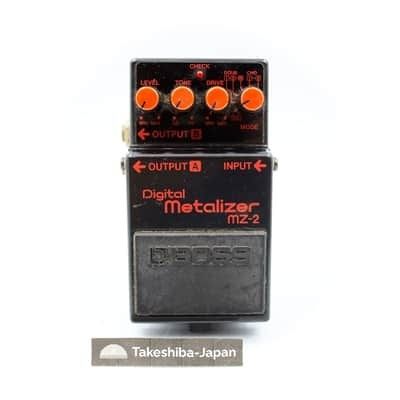
That combination explains why the pedal became more than a piece of equipment. It became a scene language. The HM-2 gave young bands a way to sound connected to one another while still leaving room for different tempos, riff structures, and vocal approaches. Its limitations imposed character. Every guitar carried the same scorched edge, but songwriting determined whether the noise became a memorable attack or mere static.
The Day Leif Cuzner Dime-Cranked Everything
The breakthrough is generally traced to Nihilist”s 1988 recording of Only Shreds Remain, where guitarist Leif Cuzner experimented with an HM-2 and refused to treat its controls as polite suggestions. The famous recipe was brutally simple: Level at ten, Color Mix Low at ten, Color Mix High at ten, and Dist at ten. Nothing was balanced. Nothing was trimmed back for comfort. The pedal was pushed until its internal personality overwhelmed the rest of the chain.
The sound became especially violent because the pedal did not work in isolation. A down-tuned guitar drove the HM-2 into a small Peavey Studio Pro 40 combo, using relatively loose .10 to .46 strings and a dropped-B tuning. The HM-2″s pronounced frequency emphasis collided with the compact amplifier”s solid-state clipping. That clash produced a dense, grainy distortion packed with upper-mid bite. The tone was not simply low and heavy. It was aggressively present, which allowed it to cut through primitive recording conditions and thunderous drums.
| Control or ingredient | Role in the Stockholm attack |
|---|---|
| Level at maximum | Hit the amplifier hard and increased the sense of forward pressure. |
| Low Color Mix at maximum | Added body and helped down-tuned riffs feel massive. |
| High Color Mix at maximum | Supplied the rasp, fizz, and abrasive edge that defines the buzzsaw. |
| Distortion at maximum | Compressed pick attack into a continuous grinding texture. |
| Dropped-B tuning | Lowered the guitar”s fundamental range without removing its cutting presence. |
| Peavey Studio Pro 40 | Contributed compact solid-state saturation and an unmistakably harsh response. |
The genius was not technical perfection. It was recognition. Cuzner and the people around Sunlight heard that the ugly interaction had a usable shape. Once recorded, the sound behaved like a wall of serrated steel, yet individual riffs remained legible because the pedal”s compressed midrange kept the guitars from disappearing into a soft low-end fog. In a conventional studio, an engineer might have corrected the excess. In Stockholm, the excess became the point.
Tomas Skogsberg and the Sunlight Cavern
Sunlight Studios was hardly a pristine temple of modern recording. Its cramped, makeshift reality mattered. The room lacked the polished infrastructure associated with major international metal productions, and that forced musicians and producer Tomas Skogsberg to work through limitations rather than hide them. Tracking spaces were tight, equipment was practical, and the recording chain could not simply manufacture grandeur. The bands had to create pressure in the room, then preserve that pressure on tape.
Skogsberg”s importance extended beyond microphone placement and console decisions. His punk and non-metal background encouraged an open-minded production ethos. Instead of sanding away every rough edge, he looked for the feature that made a band sound dangerous. That attitude proved decisive when the HM-2 produced a tone that many engineers might have dismissed as unusable. As Erik Gustafson has described in an account of the era, the classic sound grew from Leif Cuzner”s equipment and experimentation with Skogsberg, not from a rigid studio blueprint. The broader story is documented in this history of Swedish death metal”s origins.
- Guitars were allowed to remain abrasive rather than being softened into generic high-gain polish.
- Drums retained punch and attack, preventing the guitar wall from swallowing the entire arrangement.
- Guttural bass and low-tuned guitars were balanced for mass without turning the mix into shapeless mud.
- Non-buzzsaw guitar parts could use different equipment, creating contrast inside the same track.
That balance separated Sunlight from a simple distortion gimmick. The guitar tone was enormous, but it still had to serve riffs, transitions, vocals, and drum patterns. Sunlight”s records worked because chaos occupied a controlled position in the arrangement. The guitars sounded as if they were tearing through the room, while the rhythm section kept the songs moving with physical force. The studio became a cavern not because it was acoustically perfect, but because its imperfections reinforced the bands” claustrophobic, hostile music.
Entombed, Dismember, and the Golden Wave of 1990 to 1991
Entombed”s Left Hand Path, recorded at Sunlight in December 1989 and released in 1990, transformed the experiment into a landmark. The album”s guitars were not merely distorted; they were architecturally dominant. Riffs emerged from a continuous saw-toothed roar, with enough upper-mid information to remain recognizable even when the arrangements became dense. The record was completed after five recording days and two mixing days, a compressed schedule that suited the music”s directness. There was no opportunity to overthink the violence out of the performances.
Dismember”s Like an Ever Flowing Stream followed in 1991 and proved that the chainsaw tone could support more than blunt-force brutality. The band pushed the sound into melodic yet devastating twin-guitar warfare, combining harmonized leads, fast structural shifts, memorable opening riffs, and a fierce rhythmic attack. As the musicians later explained in a detailed track-by-track discussion of the album, the HM-2 character was inseparable from the record”s aggressive performances and complex songwriting.
- Entombed established the template. Left Hand Path made the Sunlight approach impossible for the international metal world to ignore.
- Dismember expanded the vocabulary. Like an Ever Flowing Stream fused melodic detail with a guitar tone that sounded ready to chew through concrete.
- Grave and other Stockholm bands broadened the movement. The pedal”s voice became a recognizable regional signature rather than a one-band trick.
- Sunlight became a destination. Bands such as At the Gates, Necrophobic, Katatonia, and Amorphis sought the room and production philosophy that had defined the early records.
The international shockwave established Sweden as an epicenter of authentic extreme metal. The contrast with the Florida sound made the distinction even sharper. Morrisound-associated productions often emphasized surgical definition and controlled low end, while Sunlight”s records made the listener feel trapped inside the amplifier. Neither approach was inherently superior, but Stockholm”s roughness carried a distinctive cultural charge. It sounded local, improvised, and resistant to the idea that extreme music needed to become clean before it could become powerful.
Why the Chainsaw Will Never Rust
The HM-2 sound survives because it remains useful wherever music needs a wall of abrasive force. Hardcore bands use it to turn breakdowns into collapsing machinery. Grindcore musicians push it toward compressed panic. Death metal revivals return to it when modern digital tones begin to feel too smooth and interchangeable. Doom, black metal, and noise-oriented projects have also absorbed its frequency profile, either through original pedals, boutique recreations, or software emulations. Boss eventually acknowledged the cult surrounding the design with the 2021 HM-2W Waza Craft reissue, while independent builders continued producing their own variations.
Its deeper appeal is philosophical. The Stockholm buzzsaw began with modest resources, questionable taste by conventional standards, and a decision to turn every knob until the speaker cones seemed ready to surrender. What emerged was a lasting argument against overproduction. A cheap pedal and a small amplifier became instruments of authorship because musicians recognized that the flaws were not obstacles. They were the identity. Every snarling harmonic and compressed rasp carried the memory of a scene willing to make ugliness sound monumental. That is why the chainsaw still cuts: it does not promise perfection. It promises impact.