
The Anatomy of Heavy Music’s Most Feared Ritual
The signal arrives before the impact. A vocalist raises a hand, the guitars choke into a tense pause, and the front rows begin to separate. Bodies slide backward. A corridor opens through the audience, wide enough to reveal the bare floor and the faces on either side. For a moment, the room holds its breath. Then the breakdown lands, and both halves charge toward each other in a collision that looks, from a distance, like organized disaster.
That first impression is powerful and often wrong. To an observer unfamiliar with heavy music, a Wall of Death can resemble mindless violence, a crowd surrendering to rage without restraint. Inside the formation, however, the ritual depends on heightened awareness. Participants read movement, protect personal space when possible, recover fallen bodies, and recognize when someone has reached a limit. The apparent chaos contains a safety net built from shared expectations. It is loud, physical, and voluntarily dangerous, but it is not without rules.
Roots in Hardcore and the Evolution of the Chasm
The Wall of Death did not emerge from nowhere. Its cultural ancestry runs through punk”s floor-level confrontation, thrash metal”s accelerated physicality, and the early American hardcore scene”s circle pits. Those older rituals transformed passive spectatorship into bodily participation. A concert was no longer simply a stage viewed from a fixed position. It became a temporary social environment in which the beat dictated movement and the crowd helped shape the performance.
Circle pits established the basic grammar. Participants ran around a central space, creating a current that absorbed individual movement into a larger pattern. As hardcore developed, dancing became more angular and expressive, with sudden kicks, lunges, spins, and open-handed gestures that communicated both aggression and release. The Wall of Death pushed that logic into a single dramatic sequence: separation, suspense, synchronized momentum, and impact. The form was especially suited to breakdowns, where a band strips the arrangement down to a crushing rhythmic command.
Festivals magnified what began in cramped clubs. A small venue can contain a pit through proximity, familiarity, and quick intervention. A festival field or arena floor turns the same ritual into a visual spectacle that may involve hundreds of people. That scale can make the event appear more reckless, yet it also makes etiquette more visible. The difference between a functioning pit and a dangerous crowd surge often rests on whether participants understand the lineage and its expectations. The evolution of moshing culture and crowd rituals shows how these practices moved from localized punk floors into widely recognized forms of synchronized audience movement.

The Cardinal Rule and Unwritten Laws of the Pit
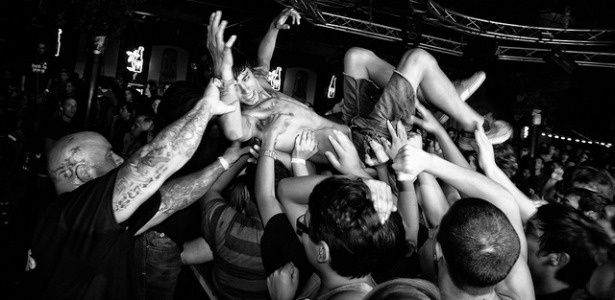
Every pit has one rule that outranks all others: if someone goes down, pick them up immediately. The instruction is simple because hesitation can turn a stumble into a pileup. A nearby participant reaches for an arm or shoulder, clears space, and helps the person regain balance. Often, the fallen person is back on their feet before the next beat lands. That reflex is not an optional courtesy. It is the foundation that allows the rest of the ritual to exist.
Other laws are less frequently spoken but widely understood by experienced attendees. The goal is not to target a specific person. Movement should respond to the music and the available space rather than become an excuse for personal retaliation. Participants should avoid the pit if intoxication, injury, exhaustion, or anxiety makes quick reactions difficult. The edge of the formation remains an important refuge, and anyone who signals a desire to leave should be escorted out rather than blocked.
- Keep eyes open and track the people immediately around you.
- Help anyone who falls, loses balance, or appears distressed.
- Do not deliberately attack people who are standing outside the active area.
- Respect visible boundaries, including people who step away or raise their hands for assistance.
- Leave room for security staff and follow instructions when the floor becomes unstable.
- Exit the pit before fatigue turns movement into uncontrolled contact.
These customs also create a form of informal justice. A person who repeatedly punches, targets smaller participants, ignores distress, or treats the pit as permission for predatory behavior will often find the surrounding crowd turning against them. Veterans recognize the difference between forceful dancing and malicious conduct. They may block the offender, warn them, move the victim away, or alert security. The pit”s reputation for danger obscures this self-policing function, but it is one of the reasons the ritual can survive across generations and scenes.
The Physics and Physiology of Controlled Chaos
A Wall of Death is not physically safe in an absolute sense. Any dense, high-energy crowd carries risks that include falls, collisions, dehydration, hearing damage, and delayed recognition of medical distress. The important point is that risk is shaped by crowd behavior, venue design, alcohol and drug use, floor conditions, security capacity, and the presence of clear escape routes. Public panic tends to treat every moving body as equivalent, while crowd science distinguishes between coordinated motion and compressive surges.
In a functioning pit, participants generally move into open space rather than compressing continuously against a fixed barrier. Kinetic energy is dispersed through lateral movement, bent knees, flexible posture, and repeated changes of direction. People absorb some impact with their legs and shoulders, while the surrounding crowd acts as a shifting buffer. Balance also depends on distributed attention. Each participant monitors not only personal footing but the movement of nearby bodies, creating a crude but effective network of real-time corrections.
That does not justify careless promotion or poor venue management. Medical research has examined injuries associated with music events and crowd movement, including the particular hazards created when density, momentum, and limited access combine. A clinical discussion of injuries associated with mosh pits is available through this medical study of concert crowd injuries. Comparisons with sports are useful but imperfect. A football match, combat event, or large public assembly can produce serious injury through falls, crowd compression, thrown objects, or interpersonal conflict. A pit differs because the risk is concentrated in a voluntary zone with fluid boundaries, but the same basic principles remain: density must stay manageable, exits must remain open, and trained staff must be ready to intervene.
| Risk factor | What increases danger | What reduces danger |
|---|---|---|
| Density | People packed against barriers or unable to move laterally | Clear space, visible exits, and controlled participation |
| Momentum | Sudden surges, slippery floors, or blocked movement | Flexible footwork, room to dissipate force, and quick correction |
| Participant condition | Exhaustion, intoxication, dehydration, or untreated injury | Water, rest, sober judgment, and willingness to step out |
| Venue response | Delayed medical access or poor communication | Trained security, visible staff, and clear emergency procedures |
The most responsible venues do not treat crowd energy as an enemy, nor do they romanticize it. They establish barriers where needed, monitor density, maintain communication with performers, and intervene when movement becomes compressive rather than recreational. Participants carry a parallel responsibility. The pit is not a place to prove invulnerability. It is a space where awareness determines whether intensity remains collective play or becomes preventable harm.
Catharsis Through Radical Vulnerability and Trust
The emotional force of the Wall of Death comes from voluntary vulnerability. Participants enter a space where balance can disappear in an instant, then trust strangers to restore it. That exchange produces a rare kind of social bond. The person beside you may be a stranger with a different job, age, politics, or background, but for a few minutes both people share the same obligations: do not exploit weakness, respond to danger, and keep the movement alive without sacrificing someone else.
The pit can also suspend ordinary hierarchy. Credentials, income, professional status, and social polish have little value when the drums hit and the floor opens. A first-time attendee and a seasoned scene veteran may occupy the same formation, provided both understand the code. The vocalist often acts as traffic controller, using gestures and spoken instructions to start, pause, or redirect the crowd. Responsible performers know that command over the audience carries consequences. The best front people build momentum while reminding attendees to protect one another, stop when someone is hurt, and leave space when the room has reached its limit.
Carrying Pit Solidarity Beyond the Pit Gates
The deepest lesson of the Wall of Death is not that danger feels exciting. It is that collective intensity requires collective responsibility. Participants learn to recognize distress through posture, movement, and expression. They learn that a stranger”s fall is not an interruption to the show but a demand for immediate action. They learn that strength in a crowd is measured less by how hard someone can hit than by how quickly someone can create space and lend a hand.
That principle extends beyond clubs and festival fields. Heavy music subcultures often model mutual aid in compressed, high-stress environments where individual attention must become shared awareness. The sound may be punishing, the breakdowns may arrive like structural collapse, and the floor may turn into a controlled storm. Yet the ritual works only when hands are ready to catch, bodies are willing to move aside, and every participant understands the boundary between catharsis and harm. Step into the gap with eyes open. Respect the code, protect the stranger, and let the noise hit without letting anyone disappear beneath it.